Resources

“The school has agreed to give us time to pay the fee. However, I am not even in a position to buy books for my children. The books cost around INR 4,500, which is more than we currently make in a month.” A garment worker in India told us this during one of our human rights risk and impact assessments

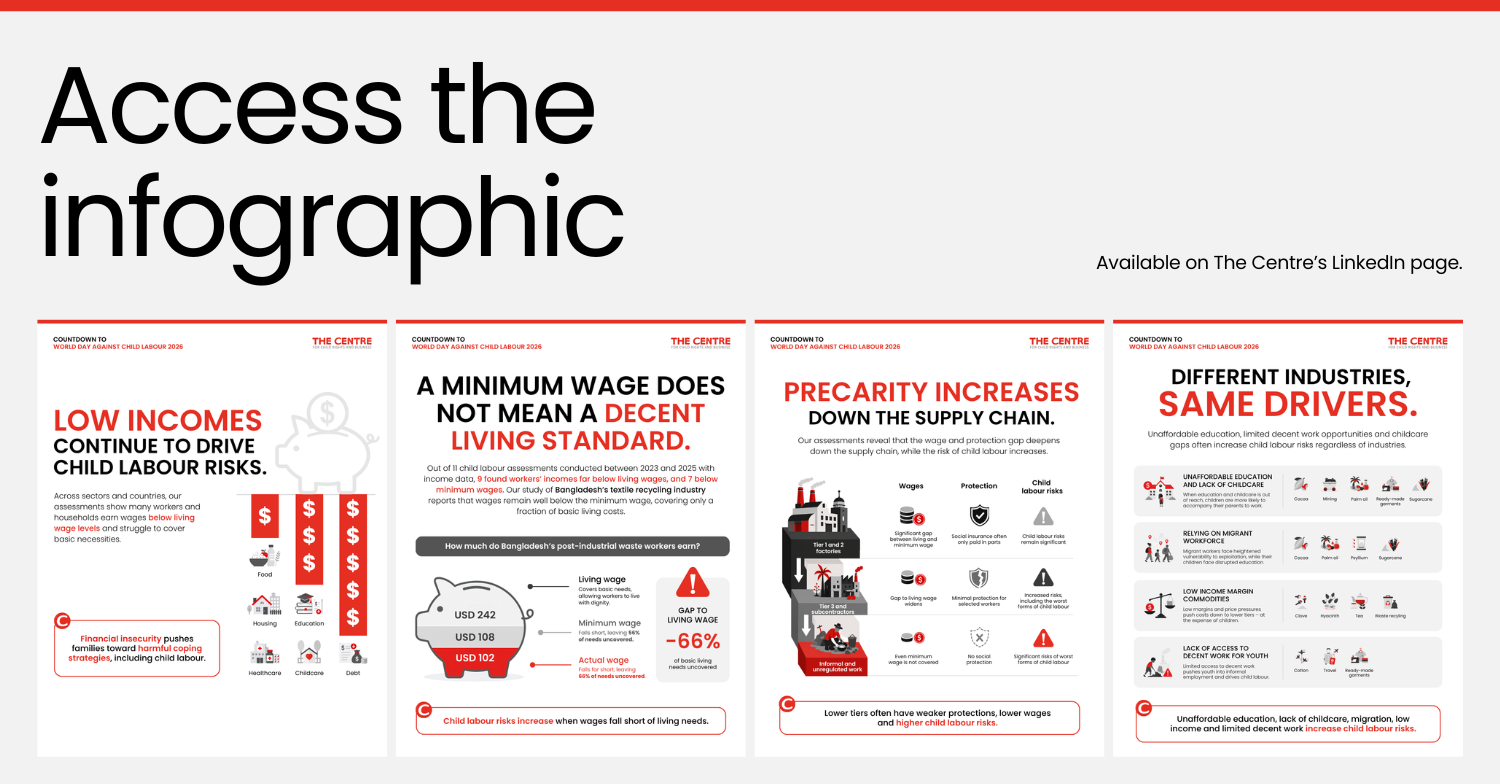
Across the child rights and human rights assessments we have conducted between 2019 and 2025, many workers connected to global supply chains have reported not earning enough to live stable or dignified lives. When families cannot absorb even basic costs, children often pay the price.
This pattern appeared repeatedly across our findings.
Of the 11 assessments since 2021 in which we identified child labour, nine found workers’ incomes lying below living wage benchmarks, while seven found them below applicable minimum wage levels.
Workers described lives balanced on extremely narrow financial margins, where food, transport, rent, healthcare, childcare and school-related expenses constantly compete against unstable incomes, debt, rising living costs and the absence of any meaningful safety net.
In Papua New Guinea, a female coffee farmer explained that even after school fees became officially free, education still remained financially out of reach for many families because parents continued paying for bags, uniforms, stationery and shoes.
“School fees are the most expensive expense for families,” she told us.
So while education may appear to be free, minimum wages may technically be paid and policies may exist on paper, the reality on the ground often looks very different.
Across multiple assessments, workers were receiving the legal minimum wage while still earning significantly below living-wage benchmarks. Full-time employment did not necessarily mean economic security. In many contexts, it simply meant surviving slightly above collapse. And that instability creates direct child rights risks.
In artisanal mining communities in the Democratic Republic of the Congo, 57% of surveyed parents said the inability to afford school fees was the primary reason their children dropped out of school. One interviewee explained the situation with painful bluntness:
“The majority of children work directly in artisanal mining to support their families’ financial needs. Due to poverty, many have no choice but to work to pay for education, clothing, food and personal expenses.”
These are not one-off stories. They reveal something structural about how vulnerability operates within supply chains. What became particularly striking across our work was how frequently child labour risks were connected to inadequate or unstable work. Workers may technically have jobs but still be unable to consistently meet basic household needs. This is especially visible where wages fluctuate, work is seasonal or irregular, or where households absorb rising costs without corresponding increases in income.
In Vietnam’s construction sector, for example, workers in some cases earned above local living wage benchmarks due to the physically demanding nature of the work. Yet the work itself remained highly unstable and irregular. Income insecurity continued to shape daily decision-making around healthcare, childcare and education. Workers described reluctance to raise grievances or take leave because missing work meant immediate financial strain.
We also saw this issue repeatedly in sectors dependent on migration and informal work. In Vietnam’s agricultural sector, we met young workers who travelled across the country to join harvesting activities, driven by the hope of making a decent living. In practice, that drive often fully outweighed concerns around protection and safety (such as by accepting hazardous work or highly informal work arrangements without contracts or social protection).
In lower tiers of supply chains, children’s work can become normalised not necessarily because families or communities disregard risks, but because economic survival gradually overrides protection.
We also need to speak more honestly about the invisible labour systems surrounding workers themselves. In one manufacturing assessment in India, a 30-year-old mother described constant anxiety about childcare. The factory where she worked did not provide childcare facilities. When her children became sick, she had to miss work and lose wages. Leave was technically permitted, but unpaid. This may not immediately appear in supply chain data as a child labour issue. But it is part of the same ecosystem of vulnerability.
When families have no childcare support, no savings buffer and no stable income protection, children inevitably become more exposed to risk, whether through school dropout, unpaid family work, sibling caregiving responsibilities or hazardous work itself.
Businesses need to recognise that poverty wages are not only social issues. They are operational risks, resilience risks and child rights risks. And importantly, businesses have an independent responsibility to respect human rights and must act to prevent and address harms even when governments fail to meet their own duties, as stressed by the UN Guiding Principles on Business and Human Rights.
This does not mean businesses alone are responsible for solving structural poverty. Governments, labour systems, social protection gaps, inflation, climate pressures and broader economic inequalities all shape these realities. But businesses are still deeply connected to the conditions within their sourcing environments, including through pricing structures, purchasing practices, production timelines and supplier relationships.
One story from Vietnam stayed with us for this reason. Hoang’s family produces water hyacinth baskets for export markets. Depending on the basket size, the family earns less than USD 1 per piece. When raw material costs rise, up to half of the household income can disappear into production expenses alone. As a consequence, every family member must contribute more labour just to sustain the household.
If producers and workers are expected to absorb every shock—rising input costs, inflation, delayed payments, unstable orders, climate disruption—then vulnerability will continue cascading downward into households and onto children.
Preventing child labour, therefore, requires more than identifying risks after harm occurs. It also requires building supply chains where workers and families are financially resilient enough to withstand pressure before children become part of the coping mechanism.
This World Day Against Child Labour, let’s acknowledge that child labour will not disappear as long as millions of workers connected to global supply chains remain trapped in poverty and economic insecurity.
View the full infographic on The Centre's LinkedIn page →

By using this website, you agree to our use of cookies. We use cookies to provide you with a great experience and to help our website run effectively.





