Resources
For many businesses, supply chain disruptions can mean delays, shortages, tariffs, price volatility and sourcing instability. But among the supply chain communities where we work, disruption is experienced very differently.
It is experienced by parents who suddenly cannot afford to keep their children in school after another unstable work season, failed harvest or mounting debt tied to wage advances. It is experienced by migrant workers navigating informal labour systems with little protection and exclusion from social schemes. It is experienced by children entering hazardous work environments because they have no choice. And it is experienced by suppliers trying to stay afloat in a growing alphabet soup of HRDD requirements, without the practical support, time or investment needed to actually implement them.
During one of our assessments in India’s agriculture sector, for example, we found that 99% of workers were migrants, and 41% of parents brought their children with them during migration. One in three of these children became directly involved in harvesting work, while half had dropped out of school permanently.
Behind these figures were stories of families trapped in cycles of instability. In our Under-the-Tree workshops, farmers and workers described recurring droughts in their home region that had made farming increasingly impossible. Many belonged to historically oppressed communities. Although some still owned land, severe water scarcity meant cultivation was no longer viable, leaving seasonal migration as one of the only remaining survival strategies.
In that same workshop, farmers expressed concern about rising fertiliser costs, increasing labour expenses and Goods and Services Tax (GST)-related financial pressure. These factors, coupled with insufficient pricing, had sharply reduced incomes and profitability. Both families and farmers described feeling squeezed from every direction: rising costs, falling returns, unstable work and growing debt.
Analysing 36 child and human rights risk assessments across countries and sectors, we identified similar patterns in nearly all of them: supply chains remain poorly equipped to absorb external shocks, particularly where buyers fail to provide sufficient long-term investment, stable sourcing relationships and practical support to suppliers and communities. Too often, the pressure is pushed downward onto the most vulnerable parts of the chain. In those instances, the risk of child labour increases.
The deeper you go into supply chains, the more fragile conditions become.
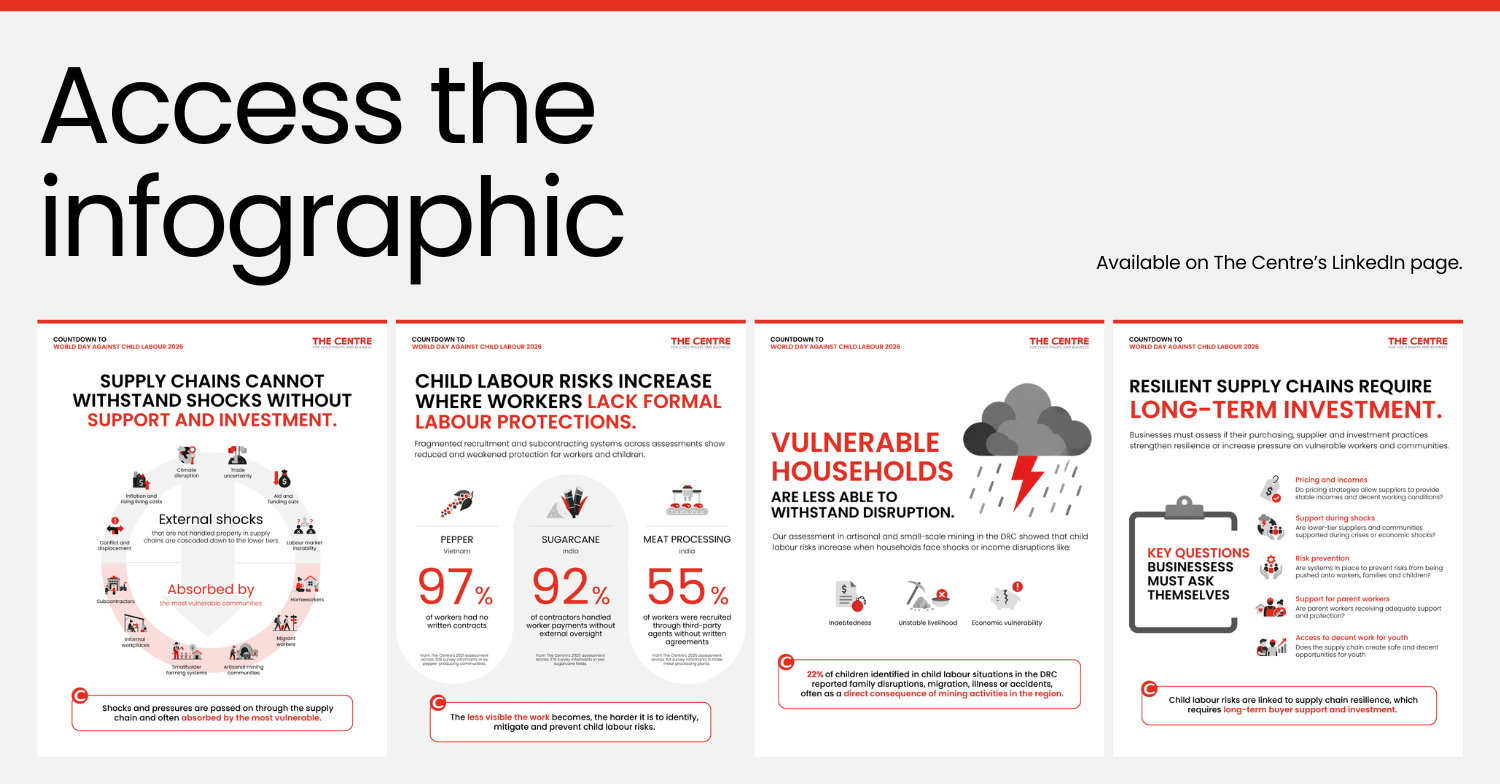
Across our risk assessments, we saw how economic and operational pressures are frequently absorbed by the least visible actors in supply chains: subcontractors, informal workplaces, smallholder farms and mills, labour intermediaries, migrant workers, home-based workers and artisanal mining communities. Yet while these parts of the supply chain are increasingly recognised as harbouring some of the most severe child rights risks, there is still limited evidence that businesses are making the long-term investments needed to build stronger supplier partnerships, improve purchasing practices, support lower-tier suppliers in meeting HRDD expectations and strengthen prevention systems.
In an assessment in three meat processing plants in India, we found that more than half of the workers surveyed had been recruited through third-party agents. In an assessment of six pepper-producing communities in Vietnam, nearly all surveyed workers lacked written contracts entirely. And in Pakistan’s waste collection sector, almost half of the surveyed children started working before the age of six and collected waste day in and day out all by themselves.
In artisanal and small-scale mining communities in the Democratic Republic of the Congo, our assessment of 907 households found that debt, unstable livelihoods and economic shocks gradually narrowed families' choices. Some parents spoke about struggling to keep children in school as costs rose and work opportunities fluctuated or dried up. Others described the pressure of informal mining economies where income instability can quickly translate into greater vulnerability for children. One statistic from the household assessment was particularly telling: 57% of surveyed parents identified the inability to afford school fees as a key reason children were dropping out of school. Parents explained that education was not something they wanted to sacrifice; it was something they felt they were slowly losing the ability to sustain.
These are stories about systems under strain—and increasingly, they force us to rethink how child labour is understood within supply chains.
Too often, child labour is treated primarily as a compliance or awareness issue: something to prevent through training and awareness-raising, to detect, audit, remove and report.
But our findings suggest child labour is only rarely a matter of ignorance of the rules or poor choices; more often, it is the consequence of a system that leaves people choosing between a rock and a hard place, where child labour becomes a form of coping—coping with a lack of access to social protection, child care and education coupled with wages far below the living wage, a bad harvest or order fluctuations that require a ‘flexible’ workforce. For many, child labour seems to be the only solution to their challenges. Telling stakeholders it is wrong or solely increasing monitoring will not create long-lasting change as it does not address any of these challenges.
The capacity of communities to prevent child labour risks is shaped by whether households, suppliers and supply chains themselves are resilient enough to absorb disruption without passing pressure to the weakest link.
When sourcing becomes unstable, when informalisation increases, when labour systems fragment, when costs rise but protections do not, vulnerability logically intensifies.
Children should not have to bear the brunt of this pressure, but, as our risk assessments show, they often do. So, what exactly do we mean by “supply chain resilience”?
Upfront, let’s be clear what it should not be: a fancy term that effectively pushes risk into lower tiers and then asks the people affected to ‘deal’ with it. Interventions such as savings groups, income diversification or financial literacy training risk becoming a rather cynical affair if they do not, at the same time, promote a shared-risk approach in which shocks and interruptions are spread across supply chains. Rather, improved supply chain resilience should be about cascading resources and practical capacity down the chain. We mean stronger long-term supplier partnerships, more responsible purchasing practices and buyers sharing more fairly in the pressure created by market fluctuations, rising costs and external shocks. We mean investment in suppliers’ capacity and resources, practical HRDD support that reaches lower-tier actors, support for community-based prevention systems, and stronger C-suite commitments to allocate adequate budgets for meaningful, long-term HRDD implementation. We also mean functioning systems to identify, prevent and remediate child labour before risks escalate.
Ultimately, these kinds of investments are what make supply chains more resilient. This might not always be the fastest way to increase shareholder value or family fortunes, but if we’re in it for the long term, it will be the only way to ensure stability and continuity in our supply chains.
View the full infographic on The Centre's LinkedIn page →

By using this website, you agree to our use of cookies. We use cookies to provide you with a great experience and to help our website run effectively.





