Resources
Over the past week, we have written extensively about external shocks and what they reveal about supply chain resilience, the impact of purchasing practices and payment structures, and the structural conditions that continue to drive child labour risks across global supply chains.
We have reiterated an uncomfortable truth: we see little evidence that supply chains are more resilient today than they were in 2023.
In the two years since our previous publication, supply chains have continued to face wave after wave of disruption. Inflation, climate shocks, conflict, trade instability and rising living costs are no longer exceptional events. They are part of the operating environment businesses must now plan for, absorb and respond to responsibly.
For this final piece, we focus on what becomes possible when businesses move beyond short-term reactive approaches and start investing seriously in the people, suppliers and communities connected to their supply chains long-term. Because, despite everything we have seen across our assessments, one thing is equally clear: meaningful progress is possible when companies stay engaged, invest for the long term and recognise that child labour is deeply intertwined with the decisions, purchasing practices and investments that businesses make throughout their supply chains.
One of the most important lessons from our work is that prevention rarely happens through isolated interventions.
It happens through ecosystems, relationships and collaboration on the ground. It happens when businesses commit long-term to their suppliers and support practical investments and interventions that reach the most vulnerable at the bottom of the supply chain.
In the Democratic Republic of the Congo (DRC), for example, the Child Rights Action Hub DRC has brought together 17 companies, organisations and donor funds to support a collaborative child labour prevention and remediation system rooted in local communities. The Action Hub works through six local NGOs, partnerships with Congolese civil society organisations (CSO), mining cooperatives, local government actors and businesses themselves. This is a model focused on strengthening the systems surrounding children and families over the long term.
Local CSOs are being trained on child-centred remediation and case management approaches. Mining cooperatives and companies are receiving practical training on child rights, HRDD and child labour prevention systems. Government actors are being engaged to align approaches and strengthen longer-term protection structures. The work recognises something businesses often overlook: local organisations and communities already hold deep knowledge and influence, but they frequently lack the sustained resources, training and support necessary to make a real impact.
Most importantly, the work does not stop at identifying risks. It also focuses on building alternatives. Prevention and remediation only become sustainable when families and young people have realistic pathways beyond the risks they are being asked to leave behind.
To name just one of the many prevention and remediation pathways currently being implemented through the Child Rights Action Hub in the DRC: through the Access to Decent Work for Youth programme, launched together with a local partner organisation, local SMEs are supported to strengthen their businesses, improve occupational safety and health performance and gain better access to markets. In return, they commit to offering apprenticeships to young people who might otherwise engage in extremely hazardous work in artisanal cobalt mines. Alongside this, young people receive training and livelihood support designed to expand their access to safer and more sustainable employment opportunities outside mining.
We have seen similar shifts elsewhere. The Child Rights Action Hub in Bangladesh has focused heavily on strengthening the systems surrounding lower-tier suppliers and vulnerable communities. Child rights focal points have been trained within communities to identify and refer at-risk children. Local child protection systems are being strengthened through collaboration with CSOs and community actors. High-risk hotspots are monitored more proactively so risks can be identified earlier, before harm escalates. At the same time, suppliers themselves are being treated as partners in prevention rather than as problems to police.
Lower-tier suppliers have participated in HRDD and child labour prevention training, including through the Child Rights Change Maker programme, which recognises suppliers working to strengthen child rights systems and improve responsible supply chain management practices. One supplier who participated in the training told us:

“Since we have never hired any young workers, we previously had limited interest in this topic. However, I now realise that responsible factories should provide opportunities for young workers in a safe, compliant way and protect them from the risks of child labour.”

Another participant explained:
“This was my first child labour training, and it introduced me to several important new concepts. I plan to apply these learnings in our factory and supply chain by reviewing key child labour policies, conducting training for our hiring team and strengthening communication with supplier factories.”
These may sound like small moments, but they reflect something important, namely that many suppliers genuinely want to improve but have never been given the knowledge, practical support, time or resources needed to do so effectively.
We have also seen how investment in decent work opportunities for young workers can directly reduce vulnerability and create safer transitions into employment. A young worker participating in the Access to Decent Work for Youth programme in Bangladesh told us:
“I am grateful for the opportunity to work at this factory as a young worker. The work is light; I only work five hours a day, and I receive a good salary. Everyone treats me kindly, which makes me feel respected.”
A factory supervisor added something equally important:
“Hiring young workers of legal working age can be a good option for factories. They are often quick learners, attentive to instructions and bring energy to their work, which can support productivity when proper guidance is provided.”
In Malaysia, we have seen another important lesson emerge: trust is often one of the most critical forms of protection. The Child Rights Action Hub Malaysia works with undocumented families within palm oil communities. Many families fear detection, detention or deportation, which prevents them from seeking support or reporting abuses. Traditional top-down approaches often fail in these contexts because vulnerable communities simply do not trust formal systems enough to engage with them safely.
Instead, the Action Hub works through local focal points, regular home visits, community relationships and practical support systems that families feel comfortable accessing.
One Child Rights Focal Point explained:
“From my experience working with the Child Rights Action Hub over the past year, I have found that remedial learning, patience and encouragement from teachers are incredibly important in helping children regain confidence and progress in their learning. Working closely with community leaders, parents and local stakeholders also helps to build trust and confidence in our efforts.”
One family supported through the programme had lost the father, who had been the primary breadwinner. Three children had dropped out of school and entered plantation work to support the household. Through tailored remediation support, the children were re-enrolled into education, lost income was replaced through stipends, and the eldest youth transitioned away from hazardous work towards building a small bakery business. The mother later said:
“Although our family faces many difficulties, this programme gives our children a chance to continue their learning and to hope for a better future.”
After years of working on child rights within supply chains, we have learned that communities do not need businesses to arrive with perfect solutions or polished sustainability language. They need consistency, investment, partnership and commitment. They need businesses willing to stay engaged long enough for systems to strengthen, trust to grow and local capacity to expand.
At the same time, we should be careful not to romanticise progress. None of these examples “solve” child labour overnight. Vulnerability remains deeply connected to poverty, debt, migration pressures, weak labour and protection systems, climate disruption and economic instability. The pressures driving exploitation across global supply chains are not disappearing anytime soon.
What creates lasting change is sustained investment in people and systems. It is businesses recognising that supply chain resilience is not only about protecting production continuity or meeting regulatory expectations. It is about strengthening the conditions that allow workers, suppliers, families and children themselves to live with greater stability, safety and dignity over time.
That work is slower, more complex and far less visible than a policy announcement or audit scorecard. But it is also the work that gives communities a genuine chance to move from vulnerability towards stability, trust and opportunity.
Thank you for following our World Day Against Child Labour campaign.
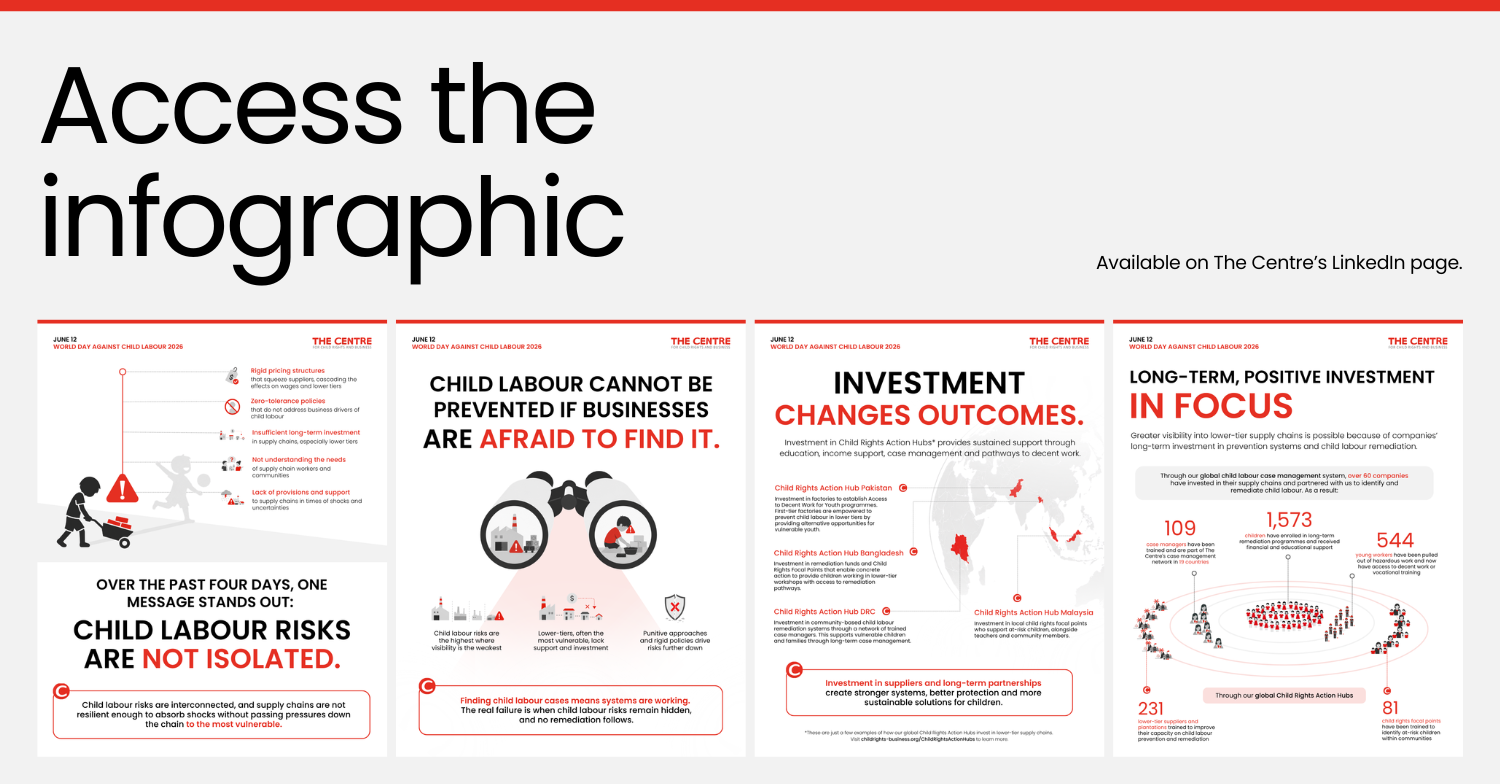
View the full infographic on The Centre's LinkedIn page →

By using this website, you agree to our use of cookies. We use cookies to provide you with a great experience and to help our website run effectively.





